Published
Author
Yasmin Morgan
XR for Health and Wellbeing
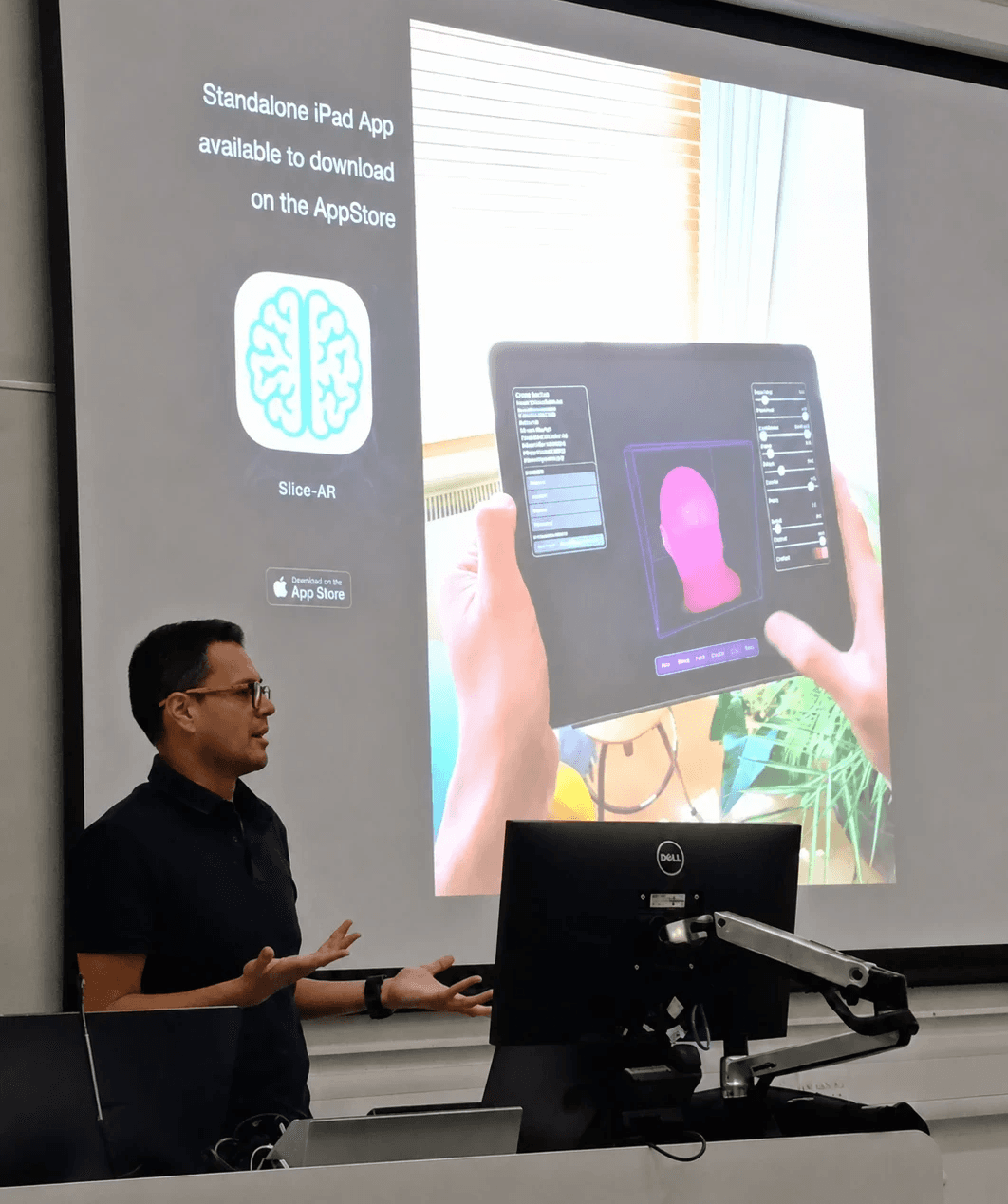
The technology to transform healthcare with XR already exists. D5XR attended the XR for Health and Wellbeing event at City St George's University in collaboration with Immersive Wire to discover how others are using immersive technologies to make a difference.
XR Potential in the Health Industry
The most compelling work in the room wasn't speculative, it was happening right now. Claudio Capelli's V Hearts project is turning patient scans into 3D surgical models. This enables surgeons to make more informed decisions before surgery, and allows patients to understand what's happening inside their bodies. XR is quite literally visualising human anatomy in a way that makes understanding easier than ever before. That is not just a prototype, it's a service with potential to be standardised.
The Body as an Interface
A recurring theme across the evening was the body itself, and how it can be used as an interface. Teslasuit's full-body haptic suit digitises human movement at a level that makes clinical training and rehabilitation scalable. Similarly, a gestural VR instrument developed by a researcher at Guildhall is being used in addiction recovery and as preparation for psychedelic-assisted therapy. Using immersive technology to connect people with their body is already being explored in new and exciting ways.
Our Takeaways
This event offered a window into how others are taking big steps towards making XR standardised in healthcare, rehabilitation and medical training. This is a community that we want to be a part of, a knowledge-sharing space where everyone understands the true potential for XR.
XR for Health and Wellbeing
The technology to transform healthcare with XR already exists. D5XR attended the XR for Health and Wellbeing event at City St George's University in collaboration with Immersive Wire to discover how others are using immersive technologies to make a difference.
XR Potential in the Health Industry
The most compelling work in the room wasn't speculative, it was happening right now. Claudio Capelli's V Hearts project is turning patient scans into 3D surgical models. This enables surgeons to make more informed decisions before surgery, and allows patients to understand what's happening inside their bodies. XR is quite literally visualising human anatomy in a way that makes understanding easier than ever before. That is not just a prototype, it's a service with potential to be standardised.
The Body as an Interface
A recurring theme across the evening was the body itself, and how it can be used as an interface. Teslasuit's full-body haptic suit digitises human movement at a level that makes clinical training and rehabilitation scalable. Similarly, a gestural VR instrument developed by a researcher at Guildhall is being used in addiction recovery and as preparation for psychedelic-assisted therapy. Using immersive technology to connect people with their body is already being explored in new and exciting ways.
Our Takeaways
This event offered a window into how others are taking big steps towards making XR standardised in healthcare, rehabilitation and medical training. This is a community that we want to be a part of, a knowledge-sharing space where everyone understands the true potential for XR.